
Never sell the myth: why did micro-strategy suddenly sell bitcoin

Author |Glog et al
The text reads as follows:
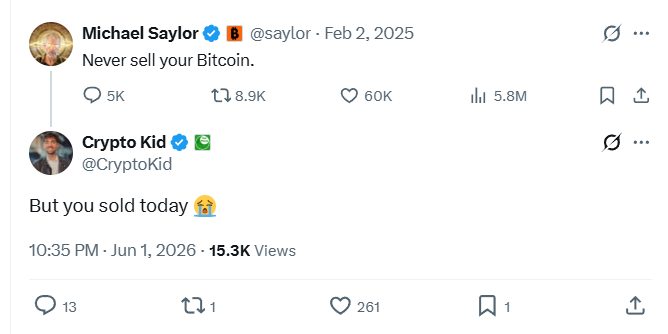
In recent times, there has been a relatively sharp reversal in the price of bitcoin, with a rapid fall in the high points of the previous period and a shift in the overall mood of the market towards prudence. Against this background, the concerns of investors were further amplified by an announcement made on 1 June 2026 by the world’s largest listed company, Bitcoin Holder Micro-Strategy (now renamed Strategy, stock code MSTR). According to the company, 32 bitcoins were sold between 26 and 31 May and approximately $2.5 million was received. It was the first time since 2022 that a micro-strategy had publicly sold bitcoin, prompting a wide debate in the market: Does this mean a shift in the bitcoin strategy of micro-strategy? Is Bitcoin's agency challenged by narrative? Will such petty sales become normal in the future
A comprehensive understanding of the incident will require an in-depth micro-strategy corporate capital operating framework. Micro-strategy, led by Executive Chairman Michael Saylor, has transformed itself from a traditional corporate software company into a globally known “bitcoin treasury”. Its core strategy is to invest almost all available financing in bitcoin. As of the beginning of June 2026, the company held approximately 84.37 million bitcoins, accounting for nearly 4 per cent of the total global supply of bitcoin, with a total cost base of approximately $63.877 billion and an average buy-in cost of approximately $75,699 per item. This large-scale hold-up has made it an important windbender for the price movement of bitcoin and a strong believer in its long-term value for many investors。
The success of micro-strategies in the past depends mainly on an efficient “prime wheel” mechanism: When there is a significant premium on the company ' s share price relative to the net asset value (mNAV) of bitcoin, financing is provided, for example, through the issuance of ordinary shares or reversible debt, and the proceeds are then used to purchase more bitcoin, thereby increasing the holdings of bitcoin per share and promoting a further rise in the stock price to a positive cycle. This pattern is strong in Bitcoin Cow, helping companies to achieve exponential growth. However, with the growing size of companies and the changing market environment, the wheel has slowed markedly in the recent past. The company ' s current mNAV multiplier has fallen back to about 1.22 times, below the management ' s long-term higher target. At the same time, the large and sustained purchase of bitcoin itself may have an impact on market liquidity as the volume of the warehouse is large. As a result, the strategic focus of micro-strategies is moving from a purely rapid expansion to more refined capital structure management and liquidity optimization。
The direct cause of the sale of 32 bitcoins is closely linked to the emergence of corporate preferred equity financing instruments。In recent years, micro-strategy has made a strong effort to issue multiple priority stock series, the most central of which is STRC (Variable Rate Series A Perpetual Stretch Prefered Stock)。SUCH PRIORITY UNITS ARE OF A PERMANENT NATURE AND DO NOT HAVE FIXED MATURITY DATES AND THEREFORE DO NOT REQUIRE PRINCIPAL REIMBURSEMENT, BUT CASH DIVIDENDS ARE PAYABLE ON A MONTHLY OR REGULAR BASIS. THE CURRENT STRC ANNUALIZED DIVIDENDS RATE IS SET AT AROUND 11.50 PER CENT, ATTRACTING A LARGE NUMBER OF INCOME-ORIENTED INVESTORS SEEKING STABLE RETURNS. PRIORITY SHARES ARE HIGHER THAN ORDINARY SHARES IN THE CAPITAL STRUCTURE, MEANING THAT COMPANIES MUST PRIORITIZE THE PAYMENT OF THESE DIVIDENDS TO MAINTAIN MARKET CREDIBILITY AND FUTURE FINANCING CAPACITY。
In order to optimize the capital structure, micro-strategies used cash to repurchase part of the debt transfer at discounted prices, pre-empting future concentrated debt repayment pressures. While reducing long-term risks, this initiative also resulted in a significant reduction in cash reserves. At present, the company ' s United States dollar reserves are around $900 million, roughly covering only about six months of priority dividends expenditure. In such cases, management chose to supplement its liquidity by selling bitcoin in small amounts rather than continuing to accumulate large amounts of idle cash. In their view, the opportunity cost of continuing to hold excessive cash in the current Bitcoin price range was high, while the long-term value-added potential of Bitcoin as a core asset remained prominent。
In essence, the small sale was not a panic sale, but a tangible manifestation of the fine management of the capital structure。It is similar to a business that covers the costs of fixed financing with a small amount of asset realization, while retaining the growth potential of most assets. As long as bitcoin is on the rise, this “micropayment, large holdings” pattern can maintain the overall positive cycle. Michael Saylor himself stressed that the company would buy bitcoin in the future in a much larger amount than it would sell, and that the operation was mainly aimed at ensuring the confidence of priority stockholders, thereby supporting the continued issuance of priority shares, the scaling up of financing and the purchase of more bitcoin。
Looking ahead, such petty sales are likely to become a new normal for micro-strategies。Companies are required to meet their interest obligations on priority shares on a regular basis, and therefore a reasonable liquidity management tool is available at the end of each month or at the end of the quarter, based on the moderate realization of a bitcoin based on actual cash requirements. The rhythm is not large-scale sales, but a gradual, needs-based exercise aimed at balancing capital costs with asset value addition. Of course, this change also reflects a strategic transition from “infinite leverage expansion” to “sustainable leverage management”. At a time when priority shares had reached billions of dollars, the maintenance of dividends capacity to pay had become a key element underpinning the entire capital wheel。
A rational view of the incident is essential for ordinary investors. Micro-strategy remains one of the strongest institutional holders of Bitcoin, whose core, in the long run, has not changed in many logics. This operation is more a tactical-level adjustment than a strategic shift. In the short term, markets may fluctuate as a result of sales pressures and price swings in bitcoin, but from a medium-to-long-term perspective, this helps companies to consolidate bitcoin reserve positions in a more robust manner and avoid the risk of cash flow fragmentation. Bitcoin ' s own price volatility properties are stronger, and recent reversals also provide a window for the market to reassess the behaviour of various participants。
Understanding the operation of micro-strategy capital helps investors to maintain a clear judgement in market noise. The institutionalization process of Bitcoin is still at an early stage, and micro-tactics amplify exposure patterns through innovative financial instruments, which, while adding complexity, also provide important models for the whole ecology. As long as the basic face logic of bitcoin -- scarcity, decentrized value storage, etc. -- – Still in place, such upgrading of capital structures would help rather than hinder their long-term development。
APPEND X FOR DISCUSSION ON DIFFERENT POINTS:
@btc overflow considers this to be a normal operation rather than a shift, saying that micro-strategies had sold bitcoin in december 2022 for tax losses, then quickly recovered and increased significantly. the small sale was a manifestation of operational flexibility and could not be confused with a fundamental shift in strategy, with a lack of memory in the market。
According to trader @WelshBullTider, the market is concerned about the signal of “the strongest holder blinks”, saying that although 32 bitcoins are a minor error in relation to 84.3 million holdouts, Michael Saylor once said that he would rather sell kidneys than bitcoins, and for the first time now the market will notice this change。
@RoleMeister and other practical analysts consider this to be a 4D-like capital management, a sale that only accounts for 0.0038% of total holdings, in order to pay SRC priority dividends, which are planned. Companies will continue to actively hoard money and sell a very small portion of it to maintain cash flows, a complex corporate financial strategy based on bitcoin, rather than a weakness。
@just stevin explains in detail the pre-planned liquidity management logic, saying that the micro-strategy is not a cash shortage, but a deliberate, small and controlled sale to prove that Bitcoin is an operational liquid treasury asset on Wall Street, and that Saylor has already predicted a similar “market vaccination” operation in May, and the company remains a net buyer。
Worried delegates, @stocktalkweekly, criticized MSTR, no matter how much it was sold, for exposing the deadly flaws of the “never-money” strategy, which has so many arguments to justify it, which has shaken the very foundations of the capital structure。
The neutrals generally agreed that small sales would become a new norm, that, as priority stock sizes expanded, micro-strategies would need to pay high dividends on a regular basis, and that the future small realization of bitcoin at the end of each month or quarter to cover liquidity needs would be a reasonable capital restructuring, not a large-scale sale, but a part of precision management。
IN GENERAL, THE MAINSTREAM DISCUSSION ON X CONTINUES TO BE DOMINATED BY RATIONAL ANALYSIS, WITH MOST PARTICIPANTS VIEWING THE EVENT AS A TACTICAL-LEVEL CAPITAL OPTIMIZATION RATHER THAN A STRATEGIC COLLAPSE, BUT THE IMAGE OF “BREATHING MONEY NEVER SELLS” DOES TRIGGER SHORT-TERM MOOD SWINGS. THE MONTHLY SALES OF DATA FOR FUTURE MICRO-STRATEGIES, THE DISTRIBUTION OF PRIORITY SHARES AND NET ACQUISITIONS WILL BE KEY OBSERVATIONS。
Theory reference:
https://x.com/0xTodd/status/20620162988472189
https://x.com/Jhy256/status/2060311582178193538
