
A dialogue that best reflects Walsh policy: inflation is an option for the Fed.
As a popular successor to Powell, he offered a reform programme that was not to be reversed, but rather to advocate that the Fed needed a “restoration” rather than a “revolution”。
Original by: Dragon Sword
Original source:See you on Wall Street
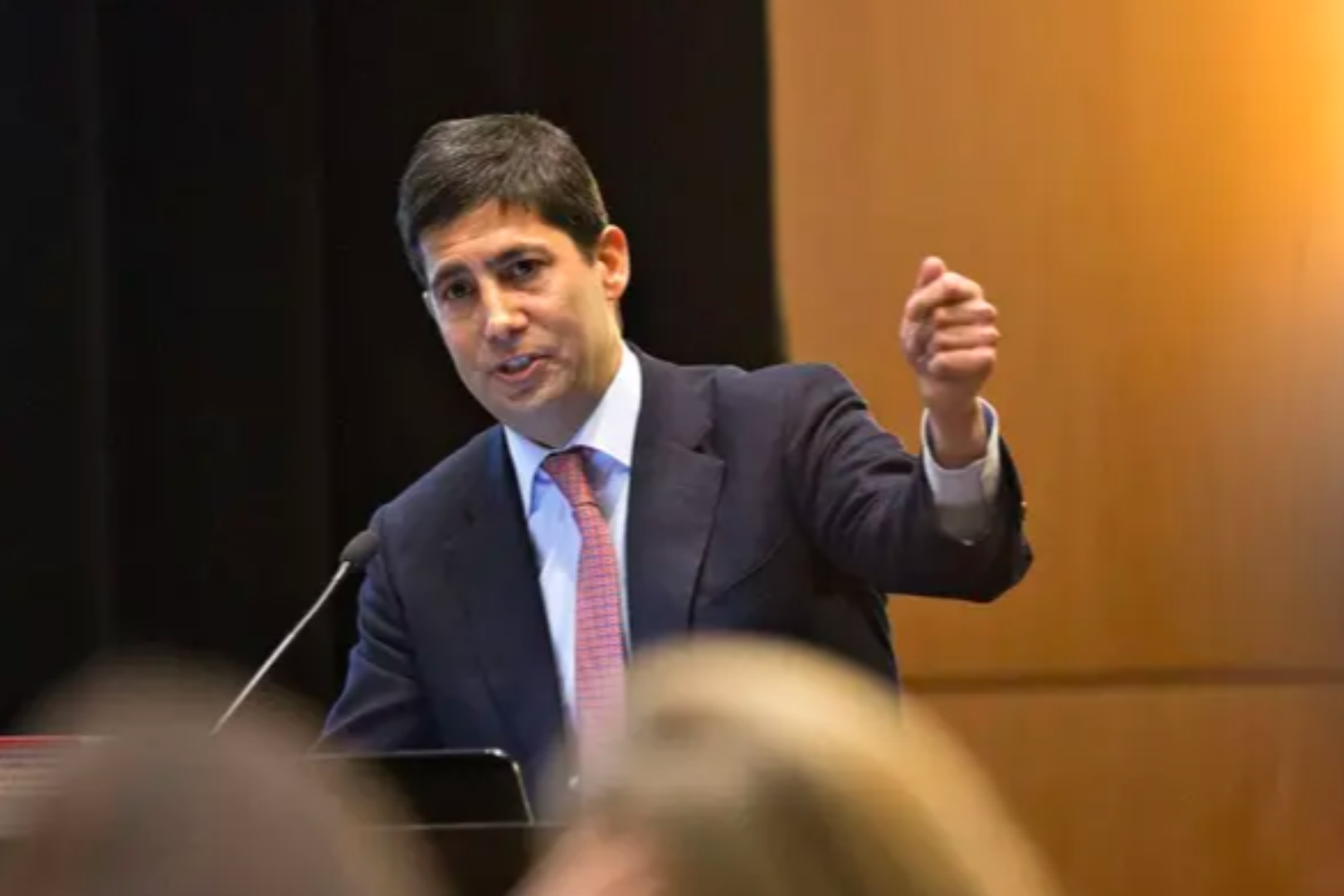
In recent daysTrump's close friend named Walsh as Chairman of the FedI don't know. If Kevin Walsh takes over the Fed next year, the market may see one of the most notable policy shifts the Fed has made in decades。
Earlier this year, in a conversation with Peter Robinson, the director of the Hoover Institute, Walsh unavoidably pointed to the current fallout of the Federal Reserve system and cast a conclusion:“Inflation is a choice.”He rejected the pretext of blaming inflation on supply chains or geopolitics, insisting that central banks were well placed to determine price levels, and that the situation was the result of the Fed’s wrong choice。
Walsh's core arguments are based on criticism of “satisfaction”. He noted that the Federal Reserve had erroneously assumed that inflation had died after the Great Moderation period, thus maintaining an overly large balance sheet during the non-crisis period. The blogger says:"When you keep printing 1 trillion here, and there's 1 trillion there, it'll come back."In his view, the Fed ' s failure to withdraw in time during the smooth period from 2010 to 2020 has led to the emergence of a real crisis (e.g. an outbreak) that has had to cross more red lines, with the consequences of today ' s inflation。
As a potential successor to the Chairman of the Fed, Walsh is not only a critic, but a reformer. He proposed specific policy paths:"If we keep quiet on the money-printer, our interest rates can actually be lower." THIS IS A VERY CRUCIAL INCREMENTAL INFORMATION — WALSH MAY PREFER TO CONTROL INFLATION BY REDUCING BALANCE SHEETS (QTS), THUS CREATING SPACE FOR LOWER NOMINAL INTEREST RATES。
This is logically compatible with the Trump government’s desire to reduce the cost of borrowing. He called it a “practical monetism”, that's what he saidThe Fed and the Treasury must “distribut their duties”:The Federal Reserve is responsible for managing interest rates, and the Treasury is responsible for managing fiscal accounts, which require some kind of “new agreement” to resolve the problem of excessive interest on debt, rather than blurring and entangling each other as in the past。
With regard to the “radical reform” of market concerns, Walsh gave a solid-minded approach。He made it clear that there was no need for “shattering reform” of the Fed, but rather for “restoration”。He compared:“It's like repairing a great golf course inspired by the past but not bound by it.”HIS VISION OF THE UNITED STATES ECONOMY WAS NOT A RECESSION, BUT AN AI-DRIVEN PRODUCTIVITY BOOM SIMILAR TO THAT OF THE REAGAN ERA. AS LONG AS POLICIES RETURN TO RATIONALITY, THE UNITED STATES ECONOMY WILL SHOW REMARKABLE RESILIENCE。
With the imminent departure of the current Federal Reserve Chairman, Powell, in May 2026 (note: his term of office will end on 31 January 2028), Kevin Walsh, a former member of the Federal Reserve and researcher at the Hoover Institute at Stanford University, became one of the most popular successors nominated by President Trump。In this critical window of time, revisiting this in-depth interview at the Hoover Institute in May this year may be crucial to understanding the course of monetary policy in the United States over the next four years。Walsh was not only a relative of the 2008 financial crisis, but also a strong monetaryist。
The interview highlights the following:
- Return to the core mission:The Fed had moved away from its core mission of maintaining price stability, with an “institutional drift” that must be reformed to regain credibility。
- Inflation is a policy choice:To be blunt, inflation was not an accident by Putin or the supply chain, but a “option” by the Fed. Central banks are well placed to determine price levels by controlling currency。
- The Fed “rehabilitate instead of revolution”:With regard to the future of the Fed, he advocated “restoration” rather than “revolution” — preserving its core architecture but removing the wrong policies of the past decade, rather than overturning them altogether. At the heart of the reform is the reduction of its $7 trillion balance sheet to contain inflation, which in turn may create room for lower interest rates, which are more important for the real economy。
- SEVERELY CRITICAL OF REGULARIZED QUANTITATIVE EASING (QE):HE SUPPORTED THE EMERGENCY FUNDING (QE1) DURING THE 2008 CRISIS, BUT STRONGLY OPPOSED THE CONTINUED PRINTING OF BANKNOTES DURING PERIODS OF ECONOMIC STABILITY (E.G. QE2, QE3 AND LATER IN THE EPIDEMIC) AS NOT ONLY INEFFECTIVE BUT ALSO CONTRIBUTING TO ASSET BUBBLES. IN HIS VIEW, THIS BROKE THE UNDERSTANDING OF “EXIT AFTER CRISIS” AND RESIGNED TO PROTEST。
- Practical monetaryism:Walsh suggested a unique path:CONTROLLING INFLATION BY REDUCING BALANCE SHEETS (QTS) CREATES SPACE FOR LOWER INTEREST RATES。
- The Federal Reserve's “transfrontier” mission:Walsh argued that the United States Federal Reserve had changed from a “last lender” to an all-encompassing “first intervener” in the banking system, and that such excesses must cease。
- Federal Reserve Treasury Divisions• Call for a new agreement between the Treasury and the Fed, as was the case in 1951, clarifying the boundaries of their respective responsibilities: the Fed is responsible for interest rates, the Treasury is responsible for fiscal accounts and avoid confusion of roles。
- Fiscal and monetary conspiracy:He pointed out that the behaviour of the Fed in purchasing the national debt (fiscal dominance) had encouraged unbridled fiscal spending by Congress, leading to a sharp increase in United States debt。
- WATCH US PRODUCTIVITY AND AI:DESPITE HIS CRITICISM OF POLICIES, HE WAS EXTREMELY OPTIMISTIC ABOUT THE ECONOMIC PROSPECTS OF THE UNITED STATES, ARGUING THAT AI AND DEREGULATED WOULD LEAD TO PRODUCTIVITY OUTBREAKS SIMILAR TO THOSE OF THE 1980S。
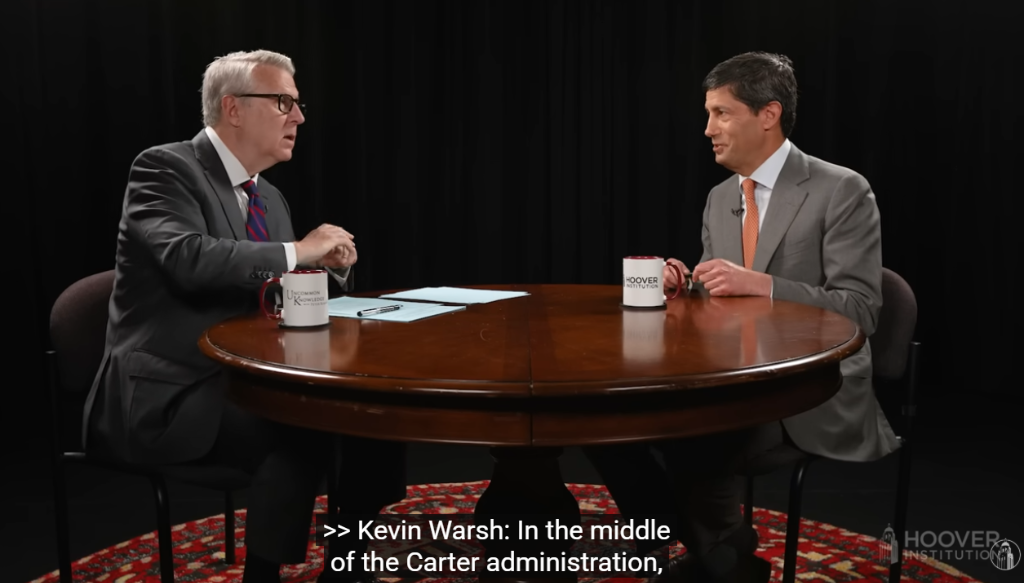
"Preliminary interview"
Date of recording: 28 May 2025
Moderator: Peter Robinson
Guest Kevin Walsh
Institution: Hoover Institute, Stanford University - Uncommon Knowledge
(THE CHINESE TRANSLATION FOR INTERVIEWS, SUPPORTED BY AI TOOLS)
Moderator, Peter Robinson
The Fed system has been responsible for maintaining price stability and fighting inflation for more than a century. How's the Fed doing? Our guest today would like to say that it should have done better. Kevin Walsh, " Unusual Knowledge " 。
Welcome to Unusual Knowledge, Peter Robinson. Kevin Warsh, a northern New York national, holds a degree in science at Stanford University and a law degree at Harvard University. Mr. Warsh worked early in the year on Wall Street and Washington. In 2006, President George W. Bush appointed him to the Board of the Federal Reserve until 2011. Please note that Mr. Walsh served in the Fed during the 2008 financial crisis, which was the worst financial crisis in more than half a century. Mr. Warsh is now allocated time between New York and Stanford, where he works for an investment company and is also a researcher at the Hoover Institute. Kevin, welcome back to Unusual Knowledge。
Kevin Walsh. 01:10
Glad to be back. You're hiding the most important thing that I happen to work for is an investment company that owns the greatest investor in world history, a man named Stan Druckenmiller. But you tried to keep a low profile, and I appreciate that. No, I just want to compliment my friends。
Peter Robinson
You keep talking about this part because sooner or later I want him on the show. We're starting to flatter him now. Okay, Kevin, first question. The Fed was created more than a century ago as a national institution responsible for preserving the value of our currency, the United States dollar. Two quotations. The first came from the late legendary investor, Charlie Munger: “Destroy money, God knows what happens.”
Peter Robinson 01:53
The second sentence is quoted from your statement last April to a banking organization called the “Thirty Group”. I took some of your descriptions of the Fed today: system drift, failure to fulfil its statutory responsibilities, contributing to a surge in federal spending, overplaying its role and underperformance. Kevin Walsh, you're attacking a sacred institution. Each of us depends on this institution every day to safeguard the integrity of the money we earn and spend. What do you want
Kevin Walsh 02:33
In the field of central banks, we are taught to hide our criticism. So I didn't do well in that speech. Peter, I describe it as a love letter, not a cold criticism. You probably didn't think it was a love letter. I'm not sure the current members..
Peter Robinson 02:53
I'm skipping... I'm skipping those parts。
Kevin Walsh 02:54
The letter of love is because the importance of this body is implied in your introductory statement. The letter of love is because, if the institution can reform itself, it can bring great success to both the institution and the country。But it does mean that it is time to get things back on track。
Kevin Walsh 03:14
I should also say one thing. This is our third central bank experiment in the United States, not because the first two were good -- they screwed up, right? It's not like winning the third Super Bowl, Peter, you know, as much as possible. The first two failures were due to the loss of the consent of the rulers and their ability to deliver on their promises。
Kevin Walsh 03:37
This is not a history class, but you can think about the Jackson era, when one would say that central banks seem to focus only on special interests on the East Coast, forgetting what happened in the central part of our country。
Kevin Walsh 03:54
This is similar to my concern today. So the central bank has existed for over 100 years, and if they can reform themselves, they will usher in another glorious century. Otherwise, I worry. Okay。
Peter Robinson
We will return to your speech later, but first, take me through it. I'm an amateur on these issues. You're a skilled central banker and investor. You know the world, I don't. So take me over again. I have a few very basic questions. Give me time to put this out。
Peter Robinson 04:25
The Federal Reserve, which was established in 1913, has powers — which may be somewhat simplistic in nature — to set interest rates and regulate the supply of money to achieve price stability. These powers are great. How's it doing
Peter Robinson
This is what the Nobel laureate Milton Friedman said in 1994: “No institution in the United States has such a high public standing and such a poor record of performance. The Federal Reserve became operational in 1914, resulting in a doubling of prices during the First World War and a major recession in 1921. The main culprits of the Great Depression are undoubtedly the federal reserve system. Since then, it has led to a doubling of prices after the Second World War. It financed inflation in the 1970s. The federal reserve system is far more bad than good, and I have long advocated its abolition.” Kevin, why do we need a federal reserve system
Kevin Walsh
So..
Peter Robinson 05:31
None of this is new to you. Milton Friedman was in Stanford when you were in Benk。
Kevin Walsh
Milton... I'm lucky to be his student. When he came here, he had a huge impact not only on me, but also on subsequent generations of students. I spent a lot of time at the Hoover Institute's archives studying what Milton said. For example, with regard to the Chairman of the Fed, our own Jennifer Burns has a great book that contains some of these communications. But I let them search and give me all the correspondence between Paul Volcker, Milton Friedman and Alan Greenspan。
Peter Robinson
Okay, give us some date background. Volcker was appointed Chairman of the Fed by Jimmy Carter in the late '70s and early '80s, specifically..
Kevin Walsh 06:14
Mid-term Carter Government. I have no exact date。
Peter Robinson
He was then reappointed by Ronald Reagan, who served until the end of the Reagan administration. Correct. Then Alan Greenspan took his place and served..
Kevin Walsh
He served for 17 years until Ben Bernanke emerged in mid-2006。
Peter Robinson 06:30
Okay。
Kevin Walsh 06:30
I remember this because I remember being a junior staff member of the White House when I found out that not only did Chairman Bernanke (who came to the White House from the Federal Reserve and returned to take over the heavy responsibilities of Alan Greenspan) wanted me to go with him and take over his former position as a Federal Reserve Commissioner. So I remember that day。
Kevin Walsh
All right, back to Milton. In those communications from Milton, it is surprising that he constantly re-examines his previous views. He continued to question whether the data and conclusions he had arrived at in a given year were still applicable in the following year and whether his judgement of that body was still applicable. In most of his communications during the Volcker and Greenspan periods, he was quite pleased with the changes in methodology, with the new way of thinking about the economy and with the success of what was later called the period of “big robustness”. So I wouldn't say Milton thought the Fed was a bad institution. He thought they had bad times and good times. I can only speculate what he will say about the “big inflation” of the last five to six years, how he will anticipate it, how he will warn it, and most likely, the Fed will not..
Peter Robinson
Listen. Okay, then one more basic question. Milton Friedman has a famous saying:“Inflation is always and everywhere a currency phenomenon.” Since inflation is a currency phenomenon, the Fed is responsible for the supply of money. So inflation is always the Fed's fault。Why don't you describe what Paul Volcker did? When Carter appoints Volcker, you'll know this. I just remember. When Carter appointed Volcker, I believe that we are experiencing the highest inflation since the civil war. When Paul Volcker left, inflation fell to about 2 per cent, or almost 2 per cent. Okay, so Milton Friedman says the Fed is always responsible。
Kevin Walsh
Yeah, so I'm sure Milton and you just conveyed the idea that, as you said in your opening remarks“Inflation is an option”. The responsibility for ensuring price stability was delegated by Congress to the Fed, most recently in the 1970s, in the context of a review of its statute, in order to have an institution responsible for prices. Don't blame anyone. We'll give you the baton, Central Bank. Go fix it。But from the comments of recent years, you don't think inflation is an option. In fact, during the last five to six years of great inflation, we heard what was said about the causes of inflation? Because of Putin and Ukraine. Yes, because of the epidemic and the supply chain. Milton will be furious to hear that. And I myself, in my own implicit way, was disturbed to hear that. These things do lead to price changes, and, after all, in a market economy, Wal-Mart prices change every day. This is how the market economy works. It is not the responsibility of the Central Bank to regulate those prices. But that's not inflation. That was a one-off change in commodity price levels. Inflation refers to what happens when changes in one-time price levels become self-reinforcing. In other words, higher prices trigger higher prices. This means that inflation ultimately affects the table of each household and the board of directors of each company, because you, as a decision-maker, do not know what the price level would be. That's not about Putin or the epidemic. That's about the Fed. That's about the Central Bank. I am afraid that in recent years, it may be because central banks have become part of our culture, and we are a little used to saying, “Well, it's not my fault, it's someone else's fault”. I think this is the most angry place Milton has had in recent times。The Central Bank can achieve any price level it wants, any inflation level. We may not like the way they do it, but they should blame others for what they think, which I think runs counter to good economic history。
Peter Robinson, 10:35
Moreover, in our next dialogue it may be important to repeat that not only “inflation is an option”, but also “a robust dollar is an option”. Volcker did it in the memory of our generation. That has been achieved. We suffered inflation, and the Fed kept it under control. Okay, one more basic question。
Kevin Walsh 10:59
If they can, they control inflation, and then I guess it's a bit cliché for economists, and after the so-called “big-stable” period, they became complacent in controlling inflation, during which prices remained generally stable for more than a generation. I think some people in my line think it's easy, in fact, because inflation is controlled because we're all very good at it. We may all be a little complacent about this, but economics is not that simple. And I think that it is precisely because of the recent new epidemic and the 2020 crisis that we are diverting our attention。
Peter Robinson 11:42
You've used that word several times. Let's define it. The period of “big robustness” began in the mid-1980s, when Volcker and the Fed, in Ronald Reagan’s term, actually reduced inflation to a lower digit, and inflation remained there, with the economy expanding until the 2008 crisis, with only a few quarters of recession lasting for about a quarter of a century. Am I right? That's what you call "stable"
Kevin Walsh 12:12
Exactly. We don't want to sound as if every year was perfect. Central bankers didn't make any mistakes, but they were relatively small and manageable. For the audience, I think inflation remains a very abstract concept. We hope that the price changes will be small enough for no one in the economy to talk about it. So we know we're done. And we know what happened in the last five or six years? Almost anything, almost anything people are talking about. Right。
Peter Robinson 12:42
That is the last basic question I would like to ask. Gold. President Nixon pulled us out of the gold standard in 1971. Until then, the United States dollar could be converted to precious metals, mainly gold, in most cases by fixed weight. This constrains the supply of money。
Peter Robinson
The journalist and investor, James Grant, wrote last year: “The opposite of the gold standard, the system that we have today, the opposite of the gold standard is actually the system that the United States is today. Some might call it a "doctoral standard". It is a system of discretionary manipulation of interest rates by doctors of economics.” So James Grant suggests that, if not gold, at least some sort of fixed commodity basket。
Peter Robinson 13:31
Milton Friedman, about the same period, when he said, as I just quoted, that he had long advocated the abolition of the Fed, said that the Fed should be replaced by an increase in the supply of a fixed amount of money announced in advance each year. It would then be entirely transparent and markets could plan 10 years earlier. Both are saying that let us find some objective criteria here. Let us find ways to limit the supply of money so that the market can know in advance, rather than leaving everything to subjective impulses, group thinking, and those who really understand the latest econometric studies in the Fed. Now, how will Kevin Walsh respond
Kevin Walsh 14:24
There is no "good old days" to return. I have many right-wing friends who believe, okay, let's restore the gold standard. The world has changed. Would it have been better or worse if we had made different choices? But you have to deal with the problems at hand. I think that's what Orwell said. Moreover, there must be a third way between “let the machine do it” and “let the central banker's latest wonders be entirely discretionary”。
Kevin Walsh
I think you and I may have learned the essence of conservatism from Edmund Burke: resisting myths。we central bankers, past and present, need to resist myths. there is one way to make clear the function of central bank reaction to incoming information. if milton were with us today, i would hate to speak for this great man, but i think he would say that there is too much “scientificism”, philosophies and attempts to refine what we still understand imperfectly。
Kevin Walsh, 15:27
Most of us in economics, if better than the average, would try to focus on the numbers on the left of the decimal point rather than on the right. Now, if we were more skilled, if we were smarter, we would be physicists and mathematicians. And most of us in this industry, initially from those areas, moved to economics, because, frankly, it is easier. So we do not understand perfectly how the economy works. If we do, we can create machines, we can create formulas. But the economy is changing every day. It is extremely dynamic. So I hesitated to say that we had a perfect rule. All right。
Peter Robinson, 16:07
Let us now turn to recent history, your recent history and that of the Federal Reserve, and the impact of the financial crisis. You served on the Federal Reserve Board during the 2008 financial crisis, which led to the worst economic contraction since the Great Depression, and the United States..
Kevin Walsh 16:27
10% unemployment. Peter, are you suggesting causality? I didn't..
Peter Robinson, 16:31
I'M LEADING THE SUBJECT. JUST PURE BAD LUCK. THE FED HAS RESPONDED WITH A SERIES OF ACTIONS, BUT PERHAPS THE MOST DRAMATIC IS THE INJECTION OF SIGNIFICANT LIQUIDITY INTO THE SYSTEM. LET ME GIVE YOU SOME SENSE OF THE SIZE OF THE FED'S OPERATION: BETWEEN THE FIRST AND SECOND QUARTERS OF 2008, THE FED'S BALANCE SHEET — AN INDICATOR TO MEASURE THE SUPPLY OF THE BANKING SYSTEM'S RESERVES — DOUBLED FROM $1 TRILLION TO $2 TRILLION IN ONE QUARTER. NOW YOU WROTE THAT YOU STRONGLY SUPPORTED THAT DECISION. SO, BEFORE WE TALK ABOUT QE2, 3, 4 AND SO ON, YOU ARE DEEPLY WORRIED (OR, AT LEAST, YOU WILL EXPLAIN LATER), TELL ME WHY YOU SUPPORTED THAT MASSIVE INJECTION INTO THE MARKET IN 2008。
Kevin Walsh 17:26
First, we keep referring to the word “currency”. I should explain this. As you suggest, Milton believes that monetary policy and inflation are about “currency”. This is heresy in modern academia. This is not taught in the introductory economics courses at most elite universities. Most come from different schools, not from this monetary school, but from Keynes. In that Keynesian school, currency is almost invisible. In fact, if you look at the Fed's minutes, they record most of what we say within the Federal Open Market Commission. It takes a long time to see the word "currency"。
Kevin Walsh
I think currency, strangely, is related to monetary policy. It's been absent from discussion. I think this is part of the reason for the resurgence of inflation. Because, um, I'm sure Milton himself would not have fully adhered to the model in his heart 30 years ago. He'll say the money's about this. And during the pre- and post-circle crisis period, the inflation boom started. We see a surge in money, whether the currency we can measure or the speed of circulation we can see。
Peter Robinson, 18:37
MV = PQ, I TRIED TO REMEMBER A LONG TIME AGO... I THOUGHT IT WAS FUNDAMENTAL IN THE FED'S DISCUSSIONS。
Kevin Walsh, 18:46
It, it, does not exist in most discussions among modern economists. Now, Milton used to say that this is the last tribute to Milton, and then we turn to the current events. Yes, Milton, I was about 19 or 20 years old, and we were just a little bit more than we are. I asked him a question, maybe to show off. I seem to know something I don't understand。He said, "Kev, the only thing we understand in economics is economics. Everything else is made up."I remember thinking, Peter, you know, maybe the old man was confused. Maybe his time is over, you know, the Nobel Prize was awarded some time before that. Until you mentioned the financial crisis, I realized that the old man was absolutely right. Nobody predicted. No one saw it, because what we really know about economics taught economics the first. At least in the first course on economics principles before the economic ideology of these elites prevailed, we said that money was related to monetary policy. I still believe it's true。
Peter Robinson 19:50
By the way, it occurred to me that when we were sitting here today, almost 20 years had passed since the financial crisis broke out. So why don't you take some time to explain what that feels like? At the time, in Washington, the Federal Reserve Board member called a friend in New York. How bad is it? We need to understand something。
Kevin Walsh, 20:10
About the crisis? I teach at business colleges not far from where we record. Over the years, I will talk about the global financial crisis, and they will look at me, and these students now have some memories, and they were not in business, but they remember what their parents looked like when they came home or when they saw it on television. Now, when I talk about the global financial crisis, they've heard about it. I might be easy to talk about the Great Depression, right? So that was a long time ago。
Kevin Walsh
How does it feel to me? As you know, I was 35 years old, and finally because of President Bush and Ben Bernanke, I found myself in this solemn position. I'm sitting in a nice office for about six to eight months, and I'm having a wonderful life. Someone will come in and feed the fireplace. The other guy would, you know, give me this little ice-water picture. I thought everything was fine。
Kevin Walsh
I had no idea it was calm before the storm. In retrospect, I felt worse than I felt, because we were in some way in a bunker together。
Kevin Walsh, 21:10
WELL, I WONDER IF BEN BERNANKE FULLY AGREES WITH WHAT I SAID AT THE IMF G30 MEETING A FEW WEEKS AGO. HE WAS A VERY GOOD AND GOOD COMBAT COMMANDER. WE ARE ALL IN THE BUNKER, AND HE IS VERY OPEN TO A SMALL GROUP OF PEOPLE WHO CAN SIT AROUND THE TABLE LIKE THIS AND ARGUE ABOUT WHAT IS HAPPENING AND WHY. HE'S QUITE OPEN TO HERETIC IDEAS. I DO NOT KNOW WHETHER SUCH HERESY IS ALLOWED IN TODAY'S INDUSTRY OR CENTRAL BANK。
Kevin Walsh 21:42
BUT IN THE DARKEST DAYS OF THAT CRISIS, PERHAPS WE COULD HAVE DEALT WITH A “B”. WE COULD HAVE DONE MORE EARLIER. WE MADE A LOT OF MISTAKES. WE ALSO HAVE SOME SUCCESSES. THE REAL ECONOMY HAS DETERIORATED FASTER THAN ANY OF OUR HISTORICAL REFERENCES. FINANCIAL MARKET EQUITY PRICES FELL BY 60 PER CENT OR 70 PER CENT, PERHAPS THE MOST WORRYING OF WHICH WAS THE SALE OF THE NATIONAL DEBT MARKET. THE AUCTION OF THE WORLD'S MOST IMPORTANT SECURITIES — WHICH IS SYNONYMOUS WITH THE UNITED STATES DOLLAR — BEGAN WITH LITTLE PARTICIPATION. PRICES VARY WIDELY, AND WE FEAR THAT THE UNITED STATES ECONOMIC SYSTEM IS ON THE BRINK OF A CLIFF。
Peter Robinson. 22:24
So, if I understand correctly, the injection of liquidity into the system and the push of funds into the system is an urgent measure aimed at maintaining the functioning of the exchange and the functioning of the market, the theory that keeping the market functioning, keeping it open and running, giving people enough money to buy and sell, is the best and most immediate thing anyone can do. The market itself will gradually solve this problem, I guess. Is that so? Is that why
Kevin Walsh. 23:05
So I'd say it's back to principle one, right? The third Central Bank experiment, to which you referred, is still in it, which was created in 1913 in response to a panic that occurred less than a decade ago. The central bank was first created, or this generation was created, in response to this panic. In the past, what we now call a deep recession, a financial crisis, is when the market fails, when there is a price difference between the buyer’s bid and the seller’s demand price, the central bank’s job is to come up with all kinds of money (the “dirty” word), so that those markets operate, not at a price, but to ensure that the buyers and sellers have a deal, where the central bank provides liquidity, and when no one else is willing to provide it。
Kevin Walsh
We are behind the banking system, not only in the United States, but in the rest of the world. Because if we screw up, it'll be worse for the rest of the world. So that's what we did in the crisis. And, you know, you and some right-wing friends of mine, including those in institutions to which we attach great importance, thought we should have the system burned. The phoenix will be reborn from ashes. You really have no reason to do this。
Kevin Walsh
That's not my point。My point is that the central bank was created to respond to panic。We met once. We met late, but we showed overwhelming strength. You use the word, I think it's right. It was an emergency, wasn't it? So you're ready to cross more boundaries than usual. In a sense, you are prepared to reach the edge of your power, as Paul Volcker put it. But we made an implicit commitment to each other at the table, to the Treasury, to members of Congress (and, in general, to other parts of the United States Government)。
Kevin Walsh
When the crisis ends, we'll quit. We will return to becoming a rather boring central bank。That should appear on the 12th edition of the newspaper, in the sixth paragraph: “The Fed is meeting today, and they have increased or decreased interest rates by one quarter.” But from that moment until now, the Central Bank became the front page. And I think it plays a bigger role than our founding fathers would be comfortable, and the founders of central banks should be comfortable。
Peter Robinson, 25:30
OKAY, SO LET'S GET THIS STRAIGHT FROM 2008 TO NOW. I'M SURE I'M MISTAKEN, SO CORRECT ME. LET ME GO OVER IT FAST. QE1. QE REPRESENTS QUANTITATIVE EASING, WHICH IS A LUXURIOUS WAY TO INJECT FUNDS INTO THE SYSTEM. QE1 OCCURRED IN 2008. WE JUST DISCUSSED IT. THE FEDERAL RESERVE ' S BALANCE SHEET ROSE FROM JUST UNDER $1 TRILLION TO JUST OVER $2 TRILLION. KEVIN SUPPORTED THAT ONE. QE2 TOOK PLACE IN 2010. THE FEDERAL RESERVE BALANCE SHEET ROSE TO JUST UNDER $3 TRILLION. QE3 OCCURRED IN 2012. THE FED RAISED ITS BALANCE SHEET TO $4 TRILLION. QE4 OCCURRED DURING THE 2020 NEW CROWN BLOCKADE, WHICH NEEDS TO BE DISCUSSED BECAUSE IT IS ALSO AN EMERGENCY. BY 2022, THE BALANCE SHEET HAD RISEN TO 9 TRILLION BY THE END OF THE NEW CROWN. SINCE THEN, THE FED HAS REDUCED IT TO $7 TRILLION. BUT, AS YOU HAVE POINTED OUT, THE FED'S BALANCE SHEET TODAY IS ALMOST TEN TIMES AS MUCH AS IT WAS WHEN YOU JOINED THE FED IN 2006 (IN THE MEMORY OF OUR GENERATION). ALL RIGHT. WE HAVE DISCUSSED QE1, QE2, QE3, THE NEW EXPANSION OF THE MONEY SUPPLY。
Kevin Walsh
You know, you keep printing 1 trillion dollars here, 1 trillion dollars there, and it's gonna come to you, Peter。I mean, remember when you were in Washington and I, the economic agencies would spend millions on this project, billions on that project. Our economies are large and robust, and we can afford to do this, even if these projects are not perfect. But when the Fed prints trillions of dollars, especially during a smooth period, it changes everything。This is almost sending a signal to the rest of Congress: we are doing it, you can do it。So let's go back to the essence of quantitative easing. QE1, by the way, we tried to market it — it worked for about a week — “credit easing”, which was our favorite name, “Nominal Kleacher?” but the word “QE” went unheeded, and we couldn't。
Kevin Walsh 27:41
What did we say? Our internal debate is whether or not to do so. That's probably the story. Peter, Governor Paulson is paying debts on Monday and Tuesday. Why don't we buy them on Thursdays and Fridays? I don't like to divulge the secrets of people sitting around the table. But I remember someone who said, uh, it sounded like a Ponzi scheme. Is there any other way you can save us from the global financial crisis? We have explained that the Central Bank of Japan did a small version of this trick about a decade ago, but not on such a large scale. We were not sure how it would work, but it worked. It was radical. Now, if you turn on economics textbooks, even prime economics, they say it like standard operating procedures。
Kevin Walsh 28:32
IT LOOKED LIKE A BET, BUT WE WERE AT A TIME WHEN WE NEEDED TO BET, SO WE DID. BUT THAT'S QE1. I SUPPORTED IT, AND I JOINED MANY COLLEAGUES IN SUPPORTING IT ON THE PREMISE THAT WE PUT THESE VERY DANGEROUS AND HIGH-RISK THINGS BACK BEHIND BULLET-PROOF GLASS UNTIL THE NEXT CRISIS COMES. BUT WE HAVE NEVER REALLY DONE THAT. SO WHAT YOU'RE ABOUT TO TELL US ABOUT THE FOLLOW-UP QE IS AT A STAGE WHERE I THINK GROWTH IS STRONG, FINANCIAL MARKETS ARE FAIRLY STABLE, AND PRICES ARE STABLE FOR A REASONABLE PERIOD OF TIME。We are beginning to do this without seasonality or cause。In doing so, we have raised the threshold for the next crisis to come to an interim level, because whatever you have done before may not be enough. I just wanted to mention one thing. You combed my résumé, and I should be grateful. I quit. You do。
Kevin Walsh. 29:26
WHEN QE2 WAS LAUNCHED IN 2010. OKAY, I LEFT EARLY 2011. MY COLLEAGUES, INCLUDING PRESIDENT BERNANKE, TO WHOM I REFERRED — WHOM I HAVE GREAT RESPECT AS A COMBAT COMMANDER — AND MY COLLEAGUES IN THE FEDERAL RESERVE DECIDED THAT WE SHOULD CONTINUE TO DO SO。
Peter Robinson 29:44
Why? If you could give the best argument for their position, what would that be
Kevin Walsh 29:50
That's, we can't see any cost. We found free lunch。Look around. Asset prices are higher. Market liquidity has increased. The economy is good. And, God, if we withdraw, we don't know what's gonna happen. In a sense, I think they are contrary to the consensus that was reached. Do any of us know what happens in situations like this? No, because again, in economics, unlike physics, there is no control group, at least no good control group. I should also say that another difference between economics and physics and mathematics is that the “atoms” we track — individuals in the economy — they change their minds, right? So we don't know how individuals react to a series of things. But their argument is that the costs are small and the benefits are high, so let us continue to do the same. All right。
Peter Robinson
QE4 took place during the new crown. The economist Paul Sheard (Paul Hilde), who I believe was mistaken for, wrote in 2021: “As the Government suppresses economic activity to contain the epidemic, fiscal policy needs to play an important social protection role by providing income support to families and small businesses. The more monetary policymakers demonstrate their commitment to achieving inflation targets through radical quantitative easing (more liquidity into the system), the better their credibility in combating inflation.” Kevin, there's a lot to read about。
Peter Robinson
Please interpret。
Kevin Walsh
When you were in crisis, like the 2008 crisis and the new coronary outbreak crisis, you know, I used to be famous for saying, "When you saw a financial crisis..." so none of these two times is exactly the same. But again, if the idea of my 2020 epidemic had been transposed, I would have been sitting in cheap seats in Stanford and New York as a bystander, and I would have said, well, this is a time when we must take radical measures. But the problem is that for most of the decade between 2010 and 2020We have no emergency. This is the period when the central bank should withdraw. However, the central bank has been occupying the front page. I should also point out that during that period of relative stability, relative peace and prosperity, Congress said that, well, since the central bank is buying all its bonds, we can spend trillions of dollars。Thus, the fiscal authorities — Congress and the President — consider all of these expenditures to be very low-cost because the Fed is subsidizing, because we are the most important buyers of these bonds。
Kevin Walsh 32:41
Then, when you find yourself in crisis, yes, I sympathize with my colleagues in crisis. Do what needs to be done in times of crisis. But if you treat every day for more than a decade as a crisis, when a real crisis comes to pass, you have to cross more boundaries. You must become more deeply involved in the private sector. And in doing so, back where you started, you will have an economic institution, which is no longer the “first of equals”, but the foremost and most important in the world. You'll see, Republican and Democratic governments..
Peter Robinson
And..
Kevin Walsh 33:16
You'll see congressmen. It's important that you see the business, they hire lobbyists to go to the Central Bank for relief. This is unprecedented and dangerous to me。It brought responsibility and accountability for fiscal policy to the Central Bank。Although my colleagues are well-meaning and may even make some good judgements, many things are not their responsibility。
Peter Robinson 33:42
Kevin, let me respond on behalf of the Fed. Yes, everything you say. But that is the case today. Inflation is now below 2.5 per cent, and despite all this, the economy continues to grow. So instead of blaming the Fed, you should say, ladies and gentlemen, good work。
Kevin Walsh
“Mission accomplished” is a very dangerous thing for policymakers in Washington. That's what you're trying to say. Then let me put it this way. Peter, in the aftermath of most crises, such as the 9/11 crisis, the global financial crisis was followed by a series of after-action reports, parliamentary reviews and blue ribbon committees. How did this happen? Well, after this big inflation, I'm still waiting for this review. On the contrary, we have just cleaned up a little, but in my view this institution is still well above its rightful role and inflation is still above the target. The Fed indicated that they were doing some after-action reviews. They're looking at their goals. They will issue the report in August this year. I wonder if their report is... capable of being reviewed for this major failureThe prices of goods and services have risen by more than 30 per cent in the last five to six years since the day before the epidemic, and federal government expenditure has increased by 63 per cent。Five years ago, I did not remember what I thought was an efficient and well-functioning Government. So, we shouldn't sweep these consequences under the carpet. So I appreciate this snapshot. The situation is much better, but there are costs to this mistake, and they are borne by the least well-off of us。
Peter Robinson
LET'S... YOU'VE MENTIONED SOME, BUT I'D LIKE TO SPEAK CLEARLY ABOUT THE DAMAGE THE FED HAS DONE. THE WALL STREET JOURNAL, WHICH I HAVE NEVER SEEN, IS A REMARKABLE THING TO CONGRATULATE YOU ON. THE WALL STREET JOURNAL REPRINTED YOUR SPEECH HERE (EXTRACTED AND REWRITTEN AS A COLUMN ARTICLE) AND THE HEADLINES COMMENTED ON YOUR SPEECH IN THE SAME DAY'S NEWSPAPER. THE NOBEL PRIZE IS NO BETTER THAN THE SIMULTANEOUS APPEARANCE OF THE WALL STREET JOURNAL EDITORIAL. SO THE WALL STREET JOURNAL SAYS THAT WHEN YOU JOINED THE FED IN 2006, FEDERAL DEBT WAS ABOUT 34 PER CENT OF GDP. TODAY, FEDERAL DEBT AS A PROPORTION OF GDP IS ABOUT 100 PER CENT AND IS MOVING TOWARDS ABOUT 124 PER CENT. AND THE WALL STREET JOURNAL QUOTES YOUR SPEECH: “IRRESPONSIBLE SPENDING HAS SURGED, ESPECIALLY AFTER THE OUTBREAK. IT'S HARD FOR ME TO EXCUSE (CAUSE) THE US FEDERAL RESERVE FOR THE COUNTRY. THE FED'S LEADERS ENCOURAGED GOVERNMENT SPENDING IN DIFFICULT TIMES WITHOUT CALLING FOR FISCAL DISCIPLINE IN PERIODS OF SUSTAINED GROWTH AND FULL EMPLOYMENT.” NOW I'M GOING TO ASK YOU THE OTHER WAY AROUND, KEVIN, BECAUSE I'VE BEEN PROVIDING A SMALL DEFENCE TO THE FED'S POLICY SO FAR. NOW I WOULD LIKE TO ASK YOU THE OTHER WAY AROUND: THE GROWTH OF FEDERAL DEBT, AS NEIL FERGUSON RECENTLY POINTED OUT IN A VERY HIGH-PROFILE COLUMN, HAS NOT SEEN A SINGLE GOVERNMENT IN HISTORY THAT HAS MAINTAINED ITS POSITION AS A MAJOR POWER AFTER DEBT INTEREST SPENDING EXCEEDED DEFENCE SPENDING. FRIEND, INSTEAD OF SAYING YOU'RE RINGING THE ALARM, YOUR ATTACK ON THE FED WAS TOO MILD. THIS IS AN ATROCITY。
Kevin Walsh 37:31
So now you want me to defend the Fed. Yes。
Peter Robinson
Role reverse. I want to see how you handle this. So..
Kevin Walsh 37:39
I believe the Fed is vital. I believe the Fed has the capacity to reform. For all institutions, “medical self-care” is important. It is not too late, but they need to raise and answer important, difficult strategic questions, rather than simply conceal them. Congress itself should also be criticized for its reckless and irresponsible expenditure, and I believe that because the Fed bought these bonds to a large extent and sent a signal to the world (what do we tell world investors when the Fed buys them? It's warm. Come on in. You should do the same, making such expenditures more acceptable. But the President and Congress should also be blamed for promoting large-scale spending in times of peace and prosperity. So, but it's very dangerous。
Kevin Walsh 38:37
I WOULD LIKE TO CONCLUDE BY SAYING THAT ACCOUNTABILITY IS TWO-WAY. THE LINK BETWEEN FISCAL EXPENDITURE (I.E. WHAT CONGRESS DOES) AND CURRENCY PRINTING (I.E. WHAT THE CENTRAL BANK DOES). WHEN ONE OF THE PARTIES IS NOT RESPONSIBLE, THE OTHER PARTY IS OFTEN NOT. WE OFTEN DO NOT IMMEDIATELY SEE THE DAMAGE DONE. AS MILTON PUT IT, THERE IS A “LONG AND VARIABLE LAG”, BUT THERE IS NO FREE LUNCH HERE. I WOULD ALSO LIKE TO OFFER A BROADER PERSPECTIVE. THEY DO THE SAME WHEN THE WORLD'S MOST IMPORTANT ECONOMIC INSTITUTIONS SEE NORMAL TIMES TREATED AS AN EMERGENCY. NO ONE CAN COMPETE WITH US IN TERMS OF IRRESPONSIBILITY. THE REST OF THE WORLD HAS LONG HELD A VIEW OF THE UNITED STATES: WELL, WE DO NOT LIKE THE FACT THAT THEY APPEAR AND TEACH US LESSONS AT MEETINGS SUCH AS G7, G10 OR G20. BUT BEFORE THE 2008 CRISIS, YOU KNOW WHAT THEY THINK? WELL, THE AMERICANS, THEY MAY BE A LITTLE AGGRESSIVE, BUT THEY DO KNOW HOW TO OPERATE THE BANKING SYSTEM — UNTIL WE DON'T KNOW. THEN, BEFORE THE NEW CROWN CRISIS, WHAT DID THEY THINK? WELL, THE AMERICANS, UNLIKE US, SEEM TO BELIEVE IN FEDERALISM, FREEDOM AND HUMAN MOBILITY — UNTIL WE DON'T. AND THEN, UM, THE CENTRAL BANK, MAYBE WE WERE TOO HARD ON THEM, BUT THEY KEPT PRICES STABLE FOR 40 YEARS. IT'S PRETTY GOOD -- UNTIL WE DON'T。The rest of the world is watching as these institutions continue to fail on important matters. And the rest of the world is looking at central banks today。If the Central Bank could fix its own internal order and disappear from the front page, thereby encouraging Congress to be more accountable for spending, then the United States would be a shining city on the top of the mountain, Kevin。
Peter Robinson 40:24
Well, Herbert Stan used to say that if something didn't last, the late economist Herbert Stan, I think he was the Chairman of the Economic Advisory Council of President Nixon, right? I don't think he ever worked for the Fed, does he
Kevin Walsh, 40:38
Not to my knowledge. Okay。
Peter Robinson
So the late economist Herbert Stan used to say, "If something cannot last forever, it will not." The problem is that we've been running an essentially Ponzi scheme. The Federal Reserve and the Treasury issue bonds for sale. The Fed buys them. It's as close as you're printing money on a printing machine. Yet the world still buys its national debt. In other words, why is the market, why is the world market not punishing the United States
Kevin Walsh 41:17
So I wanted to be clear..
Peter Robinson 41:18
Because it looks like Ben Bernanke was right. Looks like there's no price。
Kevin Walsh 41:24
That was our host Peter Robinson saying it was a Ponzi scheme. That's not what his guest said in a private debate about how it would appear. In fact, I believe in America... and I'd rather hold our cards than anyone else in the world, right? I believe we are on the eve of a productivity boom. I believe that economic growth in the United States is the most important thing and that these debts can be better dealt with than anything else. Looking at the latest report of the Budget Office of the National Congress, I would like to state that I am a member of the Office's Economic Advisory Group. They don't take my word for it. They said that growth in the United States would be 1.7 per cent or 1.8 per cent per year over the next 10 years. I think the future, um, 10 years..
Peter Robinson 42:17
They don't know. I'm sorry, I'm not on your team, but they don't know what the growth will be over the next 10 years。
Kevin Walsh 42:25
We don't even know what's gonna happen in the next 10 minutes. Exactly. So I agree, but whatever our government does, I'm willing to bet that growth will be higher. It turns out, well, I was not born as an American citizen, but we are a very productive society. Our Government may try to distort prices through quantitative easing over the past 15 years or so, but the American people will show impressive dynamism and adaptability。If our annual growth rate is 1 percentage point higher than the budget office of the Congress, in most cases it will generate an additional $4.5 trillion in revenues for the federal treasury。Right? Well, that's a good way to settle those debts. So it's not too late. But the question about you, "If something doesn't last forever, it won't."
Peter Robinson
Where's the alarm signal in the world market
Kevin Walsh 43:18
Or in our own marketWe don't want to reach that threshold, see the yellow and red lights againBecause even now, I think we are the best economies and have the most promising moments. We can see some worrying things, but I do not want to say that they are irreparable. But the longer we delay the problem, the closer we are to the tipping point. And the best way to avoid the tipping point is not so close that we see it. All right。
Peter Robinson 43:52
So, according to a March paper issued by the Budget Committee of the House of Representatives, “In an attempt to eliminate inflationary pressures caused by the Biden deficit spending boom, the Fed increased interest rates 11 times between March 2022 and July 2023. As a result, the average real interest rate on national debt doubled from 1.7 per cent to 3.4 per cent, and the net interest cost increased from $352 billion to $881 billion.” It is the $881 billion, which means that we now spend more on debt interest than on the Pentagon, which is about $800 billion。
Peter Robinson 44:36
So Kevin, the Fed still has $7 trillion in balance sheets. How does it shrink that balance sheet? How can it recover funds without interest? In other words, we are now in a difficult position to retreat. It's a terrible dilemma. And the current members of the Fed might say, "Kev, yes, don't you understand?" We are doing our best. In other words, what kind of reform agenda can you propose without making things worse
Kevin Walsh
This could upset some of your audience, Peter. So I had to start with Trigger Warning -- that's what's happening on campus. I believe that this Government has inherited a mess, a financial and monetary mess, and that it has a responsibility to get rid of it. Nobody said it would be easy. We're not in this mess overnight. And we won't get rid of it overnight。
Kevin Walsh 45:32
In order to make it easier for you to understand the figures, I think it is fair to say that we paid approximately $1 billion a day on the day before the new outbreak. Now we pay more than $3 billion a day. None of this money is spent on strengthening the military or helping the least affluent of us. This money is wasted。
Kevin Walsh 45:53
So what do I suggest? As you pointed out, and as you and I discussed, I'm not sure whether the economics community believes thisMonetary policy has two instruments. One is setting interest rates, right? The other is the currency we've been talking about. We call it quantitative easing, we call it central bank balance sheets. If we can keep the money-printers quiet, we can get lower interest rates, because what we're doing now is putting a lot of money into the system, which leads to higher inflation than the target。That's what you call a $7 trillion balance sheet, an order of magnitude bigger than when I joined the Fed. At the same time, you have another monetary policy tool, the interest rate. They do not work well together. They are not perfect substitutes for each other, but they are all monetary policies, while too many who work in central banks say that no, that balance sheet has nothing to do with monetary policy. Well, if it is related to monetary policy at the time of growth, then when it goes in the other direction, it should also be related to the implementation of monetary policy. I think we have to deal with both instruments honestly, and because I believe that growth in the real economy is a more important part of fiscal revenue, equity, efficiency and growth。
Kevin Walsh 47:17
Because a larger balance sheet leads to higher inflation, we want to reduce it. We can't do it overnight. We would like to see some kind of agreement between the Treasury and the Fed, as was the case with the Treasury and the Fed in 1951。
Kevin Walsh 47:34
Who is responsible for what? Who will manage the interest rate? The Fed. Who will handle the fiscal account? Ministry of Finance。We have blurred these lines of attribution of responsibility. When a president comes into office, his finance minister should assume his responsibilities as a financial authority, rather than obfuscating responsibility to the Fed, which would only bring politics into the Fed, and I think would interfere with their normal functioning。
Kevin Walsh
In my judgment, we should reduce the central bank balance sheet and get the Fed out of these markets unless and until a crisis arises. That way, you'll reduce inflation。You and I might call it “practical monetaryism”。I think this is our intellectual error, or that our intellectual mentors might consider it. By doing so, you may actually be able to achieve lower interest rates, which are more important for the real economy than for the balance sheet. All right。
Peter Robinson 48:37
Kevin, let me finish your two visions of this country. Let me use some other quotations to prepare the mattress. This is what you, Kevin Walsh, said: "For about 40 years — starting with the `Big Valiant' period, that is, beginning with the mid-1980s — Americans barely consider changes in price levels. This is how things should work. We can take that for granted, because intelligent and hardworking people allow the rest of the country to function properly.”
Peter Robinson, 49:14
Correct. All right, this was what former Federal Reserve Chairman Alan Greenspan said when he testified to Congressman Henry Wexman during the 2008 financial crisis: “I made a mistake by assuming that the self-interest of the organization — particularly the banks — was sufficient to enable it best to protect its shareholders and equity”. From Alan Greenspan, who started his career as a fan of Iin Land, was one of the deepest believers in the American free market in the twentieth or twenty-first century. This is a statement. Wexman said, "In other words, did you find your free market ideology unworkable?" Greenspan: That's why I'm shocked, because I've been holding that view for 40 years and there's ample evidence that it works
Peter Robinson 50:10
WELL, IT'S A VISION: STARTING IN THE 1980S WITH FED CHAIRMAN PAUL VOLCKER AND PRESIDENT REAGAN, WE ACHIEVED A LOW INFLATION AND A ROBUST DOLLAR. OVERALL FEDERAL SPENDING IS LOW ENOUGH TO ALLOW ECONOMIC GROWTH. IN FACT, IT GREW FASTER THAN FEDERAL SPENDING. WHEN GEORGE W. BUSH CAME TO POWER, BEFORE THE START OF THE NEW WAR, WE WERE ACTUALLY RUNNING, OR WERE EXPECTED TO RUN SURPLUSES FOR SEVERAL YEARS, BUT THAT ENDED. THE FINANCIAL CRISIS HAS CHANGED THE WORLD. WITH THE NEW CROWN BLOCKADE, WE NOW HAVE MORE THAN A DECADE OF FISCAL IRRESPONSIBILITY AND MARKET DISTORTIONS. NOW YOU HAVE MARKET PROFESSIONALS LIKE JAMES GRANT AND RAY DARIO EXPRESSING DOUBTS ABOUT THE MONETARY SYSTEM AS A WHOLE. YOUNG ENTREPRENEURS BUY BITCOIN BECAUSE THEY NO LONGER TRUST THE DOLLAR. KEVIN, SOMETHING BASIC IS OVER AND IRRETRIEVABLE. WHAT DO YOU THINK OF THIS VISION
Kevin Walsh 51:18
This is ridiculous. I'm really, I'm not a giveaway. This country is not a giveaway。The country is on the brink of productivity prosperity。IT SEEMS TO ME THAT THIS WILL MAKE YOU AWARE OF THE PRODUCTIVITY BOOM — THE ONE THAT TOOK PLACE IN THE 1980S — WHEN YOU WERE PRESIDENT OF THE OVAL OFFICE. AI。
Peter Robinson 51:42
MORE THAN AI. SO TELL ME YOUR VISION. TELL ME WHAT HAPPENS IF WE DON'T KEEP MESSING UP. OUR..
Kevin Walsh 51:50
For more than 15 years now, the Government has made every effort to intervene in and undermine the market economy。Despite our best efforts to weaken the United States and its role in the world, we have tragically failed。
Kevin Walsh 52:03
THE 21ST CENTURY COULD BE AMERICA'S, RIGHT? WE HAVE A REAL RIVAL, A G2 COMPETITION, JUST AS YOU ONCE COMPETED WITH THE SOVIET UNION ON THE OTHER SIDE OF THE PLANET. WE MUST TAKE IT VERY SERIOUSLY. BUT, GOD, I'D RATHER HOLD OUR CARDS THAN THEIRS. THE OVERALL IMPLEMENTATION OF PUBLIC POLICIES NEED NOT BE PERFECT. YOU AND I CAN IMAGINE, WITH YOUR COLLEAGUES HERE, WHAT KIND OF TRADE POLICY, REGULATORY POLICY OR TAX POLICY IS PERFECT. OF COURSE, PERFECTION IS NOT A NECESSITY。All we have to do is make policy a little better than it is now, leading back to meaningful monetary and fiscal policies, and the United States economy will prosper。
Kevin Walsh 52:46
Now there is a tendency among some of our colleagues to say, well, we should do what Reagan did. But those days are over. Hayek, I think there is a famous saying: it is the job of people like you and me to re-state past thoughts and rethink them in the minds of a new generation. So this is not a return to Reaganism, but rather a new set of economic policies in a new world that can drive the American spirit and drive individual freedom and liberation. What is important is that they need institutions like the Fed to restore what they once were: those that were in a secondary position for most of the time and that were only involved in and withdrawn in certain circumstances. In doing so, we will have more responsible fiscal policies and higher economic growth, which began with a new generation of technology in the United States, which I am sure will be a great beneficiary. This is not meant to be, nor is it an inherent right, but I believe it is not only possible, but it is likely to happen。
Peter Robinson 53:56
Two final issues. The Fed does not need to be completely overthrown. It does not need to be smashed and rebuilt. It only needs to correct the current course several degrees. The carrier adjustment takes time, but can be solved several times. Am I right
Kevin Walsh 54:17
I think so. The Fed does not need a revolution. It has experienced a revolution in the past decade. What it needs is a degree of recovery. Now, I don't know... I know you're not a golfer, but I learned this from a famous golf course designer, Gil Hans。When he looked at these golf courses and thought about how to make them great again, he said that he was inspired by, but not bound by, his past. Faithful to the idea of the designer of that golf course — here, the central bank. Faithful to it, but without having to recreate it literally。
Kevin Walsh 54:56
It's like we can't go back to the regulatory policy of the Reagan period, or the fiscal or tax policy of the Reagan period. We cannot return to the monetary policy of the Reagan period, but we can look back at an institution and try to restore its best elements, bearing in mind that the world is changing。You mentioned bitcoin, and I seem to have heard a little insult about people buying bitcoin。
Peter Robinson
Isn't that right, Charlie Manger, two or three years before he died, Charlie Manger attacked Bitcoin? He called it evil, partly because it began to weaken the Fed ' s ability to manage the economy。
Kevin Walsh 55:32
Either it can provide market discipline or it can tell the world what needs to be done. Bitcoin..
Peter Robinson
Doesn't make you nervous
Kevin Walsh 55:40
Bitcoin won't make me nervous. I can think of one dinner here in 2011 and another person who's been on your show. I won't say his name. Okay. I just said that。
Kevin Walsh 55:55
Mark Anderson, he showed me the white paper, the original white paper. I wish I had understood as clearly as he did how transformative bitcoin and this new technology would be。
Kevin Walsh
Bitcoin doesn't bother me. I think it is an important asset to provide information when policymakers are doing right or wrong. It's not a substitute for the dollar. I believe that it can often be a good monitor of policy. If I was to say more broadly, what might Charlie Munger and the others think? A large number of securities emerge under various names, many of them, if not most, whose transaction prices are not that high。
Kevin Walsh 56:42
So what did Charlie say, maybe his friend Warren did? There are innovators, imitators and incompetents. There are real innovators around that new technology. I would like to emphasize to business and bankers that Mark tried to show me the bottom-up technology in that white paperIt's essentially softwareI don't know. It is just the latest, coolest software that will enable us to do things that we never did before. Can this software be used for good and evil? Yes, both, like all software. So I don't devalue it like that. And if one last thing is that these technologies are being built here. I'm not just talking about Stanford campus。
Peter Robinson 57:49
Last question, Kevin. Last question. You're back in Manhattan, working with one of the greatest investors in the last half-century, Stanley Drukken Miller. You're famous for investing in macros. You look at global trends。
Peter Robinson
So you saw, and I know you saw the details, because I know you've been on several field trips to China. In China, hundreds of millions of people have been lifted out of poverty and have built a modern economy since the late 1970s. We now see India growing and India becoming more open to markets. It lags behind China, but it is catching up. We even see that I say “even” because, for many, these places have been considered problem areas for decades. However, there are real signs of economic growth in sub-Saharan Africa, such as Nigeria and Kenya. With all this in mind and understanding, Kevin Walsh still has a long-term view of the United States。
Kevin Walsh 58:52
Absolutely. If you can say a few words. Of course, you mentioned that the United States is an innovator of almost all these technologies. Now, can they be used elsewhere? Absolutely. The most talented people in the world still want to come here. The most talented people in America want to build here。
Kevin Walsh
I believe that economic policy has been shifting in a better direction than before over the past six months. Economic policy is imperfect and never perfect. But the American people are ready to free themselves from the shackles that they have always endured。
Kevin Walsh 59:37
All the policies discussed in, around, around this table and elsewhere. We have also failed to mention the regulatory taxes that have caused enormous damage to United States economic growth over the past decade. I believe that, in part, the tax burden is decreasing, and we talk about this productivity revolution. We talked about technology in a sense. But I think that human beings are underestimated, especially Americans, whose ability to adapt to new technologies and thrive is, I think, very real. This may sound blindly optimistic to some of your listeners, but we used to call it the micro-basis of macroeconomics, and I will translate broadly into another trigger: the culture that is taking place in society, the willingness to take risks, fail and take risks again. This still happens more in the United States than anywhere else. They did not take place at that rate in France and Germany. This is a very exciting moment, as we remove that regulatory tax and as we resume some of the economic policies that worked better in the past。
Kevin Walsh 01:00:55
As we now reform institutions. I'm willing to bet on the growth potential of the United States, and I'm willing to bet that the central bank will fix what has been destroyed and stabilize prices again. The rest of the world may not love us, but they will look to the United States again and say that, while there are some things we do not like, they are growing faster, and that is where we want to channel capital。
Peter Robinson 01:01:23
Kevin Walsh, thank you。
Kevin Walsh 01:01:25
Thank you, Peter. It's an honor to be here again。
Peter Robinson 01:01:28
This is Extraordinary Knowledge, Hoover Institute and Fox National Channel. I'm Peter Robinson。
Note: The Chinese translation may not be 100 per cent accurate。
