
The art of arbitrage is the ultimate ability of the founders of encryption

Author: Yuan Han Li, Blackchain Capital Partner
Photo by Luffy, Foresight News
original link: https://www.techflowpost.com/article/32225
Statement: For the purpose of reproduction, readers can obtain more information by linking to the original language. If the author has any objection to the reproduction, please contact us and we will proceed with the modifications requested by the author. Reproduction for information-sharing purposes only does not constitute any investment proposal and does not represent the views and positions of Wu。
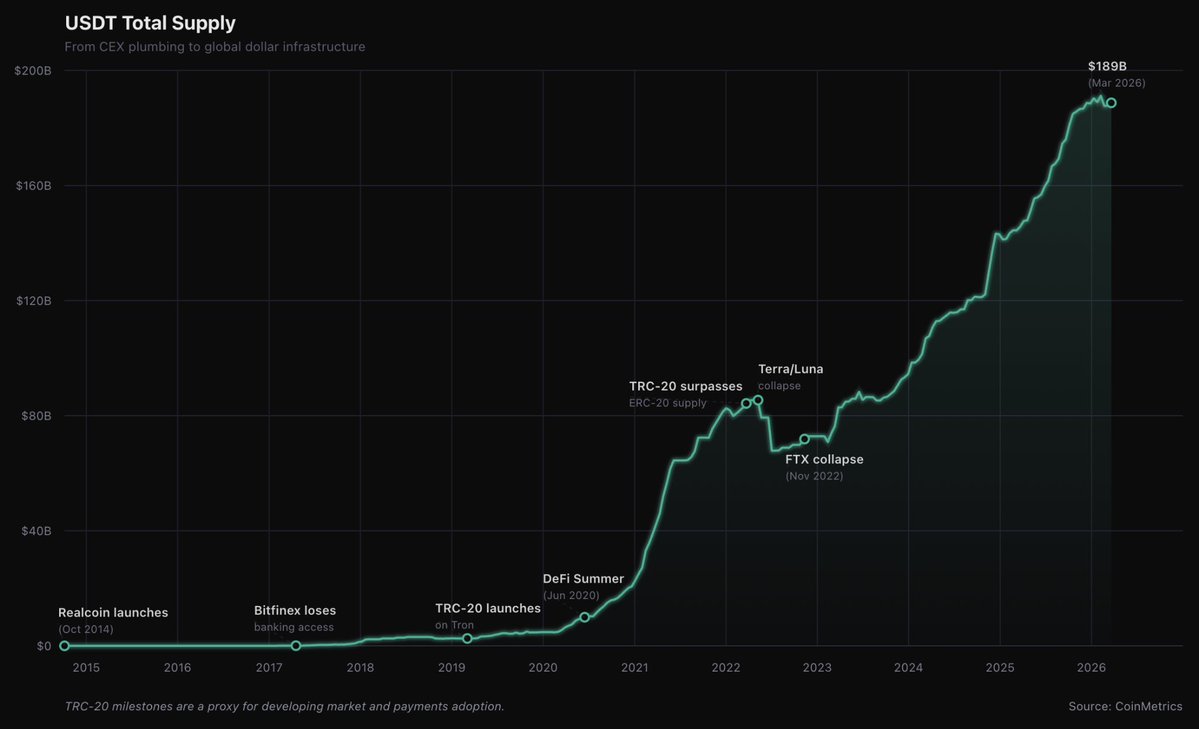
Tether ' s current daily transaction settlement is larger than most traditional payment networks. It has come to this day by taking on the need that all banks do not want to touch: a dollar-stabilized currency that exists 24 hours a day, 24 hours a day, without any scrutiny。
When the USDT was launched in 2014 by Bitfinex, its original purpose was to transfer funds between major exchanges and bypass banking channels. This model has been a major success, and USDT has become the core of all head-centre exchange spot-to-renewal contracts, deeply embedded in the bottom of the exchange. When the money was tried to replace it, it failed。
Tron's appearance has since rewritten the pattern, with low-cost transfer charges making USDT a common dollar asset for people in Latin America, sub-Saharan Africa and South-East Asia. The service was originally intended to be an exchange money flow, but it unexpectedly reaped another group of core users – ordinary people in high-inflation countries who desperately needed to preserve their dollar assets. Tether built a financial infrastructure that served completely unexpected populations. Today, it is one of the world ' s largest in-kind gold holdings。
Technology itself was a secondary factor, and what was really critical was the huge gap between market demand and traditional banking capacity. None of the front-line companies in the encryption industry have seized such supply and demand gaps, built positive growth cruises and pre-empted traditional giants before filling the gap。
This business model has a more precise definition: arbitrage. Rather than narrow financial price differentials, it is to exploit supply-demand faults that are long-standing among different markets, between regulatory systems, on a scale that traditional giants are hard to block immediately, building on faults to build growth wheels; and transforming short-term dividends into core barriers of long-term sustainability before window closure。
The complete arbitrage path is divided into three steps: digging the gap between supply and demand, building the growth wheel and completing the business maturity transformation. The vast majority of teams in encrypted tracks can complete the first two steps, the third most difficult。
The first two steps would require deep-farming and encrypted capital markets to understand the flow of funds and how various products attract liquidity; the third would require a completely different set of systems: a compliance framework, institutional trust, consumer-grade product standards, and banking and financial science and technology cooperation. The founders of the three complete stages are "bilingual": they know the market for encrypted money, and they can eat the traditional financial and mass market rules. Such people are scarce, but they are able to build cyclically green enterprises。
Cold Start: A growth wheel based on encrypted original dividends
The first two steps of the arbitrage -- digging up gaps and building growth wheels -- are at the core of a deep understanding of the encrypted market, as is natural for industry rules. Of the total number of encrypted transactions in North America in 2022 to 2023, 76.9 per cent came from large transfers of more than $1 million; on the Polymarket platform, cumulative transactions of more than $50,000 became a top 5 per cent global user. Encryption market users cannot simply be equated with ordinary consumers, in essence capital markets: giant whales, marketers and professional trading agencies view platforms as core financial infrastructure. As a result, the encryption industry's moats are becoming more late and retreating faster; a barrier that is truly sustainable will take years to settle, and even if the bottom code can be replicated, it will not be repeated。

market share of leading firms in various areas of the encryption industry, source: decentralized.co
There will be no long-term barriers at the beginning of the project, depending solely on community recognition and precision as to the flow of funds for completion. The three core drivers of cold start-up are often intertwined, testing each founder ' s understanding of the different dimensions of the encryption market。
Speculative demand: the most mainstream mode of initiation
Industry public opinion tends to go to two extremes: either brainless speculation or a critical sense of ethics, with both perspectives being biased, with the latter being particularly negative. Objectively, speculation is the most stable cold starter in the encryption industry's history。
Tether started with speculative capital flows on the full service exchange。
Circle caught DeFi in the middle of the summer, and mobile mining users urgently needed a credible and stable currency to exchange various governance coins. While it was known to all at that time that the vast majority of mining coins would eventually be zero, the real demand for United States dollar-stabilization in the chain was unprecedented. Circle did not prejudge the DeFi boom, but introduced compliance, transparency, and a little "conservative" in the encryption circle ahead of time, and the boom was a temporary response to the demand for market confidence。
Ethena has opened up another group of users to seek money for its benefits. Synthetic United States dollar USDe generates revenue from the arbitrage on the basis of the cash-and-renewal contract, with a maximum of $14.5 billion in lockouts and third-largest stable currency in the world, cumulatively generating more than $480 million in cost income. This cold start is based entirely on encrypted primary finance, and the speed of expansion is almost right in DeFi history。
But not all projects rely on speculation to start。
Just-in-demand drive: the failure of traditional financial channels has led to the spread of encryption products
When the current financial system is costly and excludes large segments of the population, there is a need to directly promote universal access: in high-inflation economies, high cross-border remittance lines, and the inability of people to open dollar savings accounts. When people feel pain enough, they need not educate the market, but only a set of available transfers, savings channels. RedotPay is a case in point: this encrypted payment card company was established in mid-2023, and the end of 2025 saw an annual gain of $150 million, and the product supports user-held, consumer-stabilized currency with a digital banking interface。
Such models cannot be conceived in the New York, London writing buildings and must take root in the needs of the field. The same product, which is only a novelty for Manhattan residents, is a guarantee of survival for ordinary people who cannot easily hold the dollar and lack the bank cards available, which is the arbitrage between supply and demand。
The core strength of RedotPay lies in the fact that the team at the same time has access to two systems: the encryption chain uplink and the distribution channels under the emerging market line. User retention rates are higher because they do not pursue short-term gains, but rather address chronic financial distress。
Subsidy incentives: coin credits, air drop-off subsidies
Subsidies can build up early trade volumes before natural demand is formed; the dynamism of subsidies alone looks exactly like real market demand before subsidies cease. But well-designed and quantifiable incentives can accelerate real demand extraction rather than simply create false prosperity。
Hyperliquid is the pole that has subsidized operations in recent years. Large-scale crediting activities and air drops attract big traders, but the bottom product itself has the best industry power -- the speed of transaction response, the high mobility, the experience of trade not to lose the central exchange. The subsidy is simply a knock-on brick and a hard product to keep the user. The Platform ' s trading volume has not shrunk after the incentive has ended, but has continued to rise。
Each of these three types of driving forces attracts the participants first. Even in emerging market demand-driven products, funds go through encrypted intermediaries such as exchanges, wallets, chain agreements and eventually reach ordinary end-users. The early growth of almost all successful encryption enterprises is dependent on an understanding of the logic of the operation of encrypted capital markets; the system is not understood, and cold start-ups are tantamount to seeing the blind。
However, encrypted market recognition alone will not be sufficient to complete the business maturity transformation。
The transition from the encryption circle to the public
It would not have been easy to get a cold start, and the vast majority of firms would not have been able to jump out of encrypted raw traffic and achieve normalized profits for the public market. All the companies mentioned in this paper have faced the same ultimate torture: Is the product still valuable when the core user is no longer a professional trader in encryption
A large number of teams have gone through the cold start-up phase and have finally failed。
Operating ideas that fit cold start-ups, such as fast iterative generation, deep-growing communities, and fast-on-line, may become a drag in the transition phase. The new user community looks to standardized client service, a very simple interface, compliance systems as the base configuration; growth channels shift from currency drops, community marketing to banking, financial technology, business cooperation; revenue quality is more important than the scale of the transaction; and corporate operations need to stabilize predictable processes, which are completely unnecessary at an early stage。
Circe is a model for successful transition. Before the full stabilization of the federal regulatory framework, it had built up a compliance system several years earlier, with a deep-tilled institutional financial linguistic system, while the entire encryption industry had focused only on the circle. In July 2025, when the GENIUS Act came to the ground, the first federal stable currency regulatory framework in the United States took shape, and the early layout of Circe was no longer conservative but forward-looking. The company landed at New York House and received $2.7 billion a year, and USDC was in circulation at $75 billion. Speculative funds still exist but are no longer fully operational。
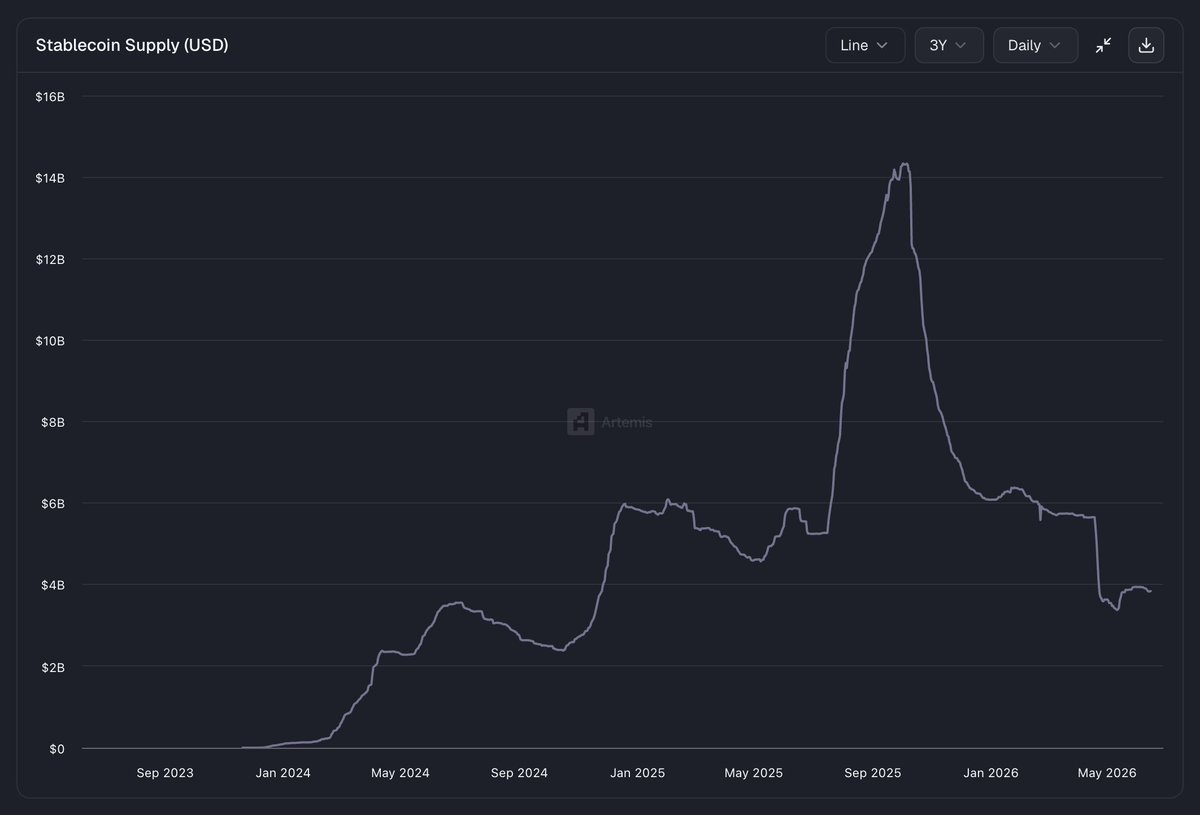
Ethena is in an uncertain phase of transition. At the end of 2025, the margin earnings were narrow, and the platform ' s locks were close to cutting. Its cold start depends entirely on a single mechanism: the real-life contract base trade continues, and the core task of the transition is to move away from a single source of revenue. Ethena synchronized several lines of operation: the introduction of compliance packaging products for institutional export earnings, the issuance of USDtb stabilization coins by the Itobered BUILL Fund, the construction of a permanent contract exchange based on Hyperliquid HyENA, and the opening of stable coins as services for other ecological issuances. The reserve asset structure has been significantly restructured, with the guarantee of a lasting contract accounting for USDe reserves falling from 93 per cent to less than 5 per cent by mid-2026. The ability of these new operations to absorb the original growth engine on a large scale remains to be tested, but the direction of the transition is clear: Ethena is studying traditional financial rules simultaneously, and the time window is tightening。
The failure of "single mode" (note: in this paper, words are focused on encryption, ignoring traditional finance; bilinguals know both) can be foreseen, and many teams are caught in the wrong spot:
- 1. Misperception of the product market match for the amount of false transactions resulting from subsidies
- 2. The founders cannot simplify the logic of the product and fit the general public
- 3. Unlimited delays in compliance and, ultimately, the supervision of summonses
- 4. There has been a continuous loss in the user circle, without any adjustments in the recruitment, testing and routing of products。
There is also a more subtle monolingual thinking: the founders have completely bypassed the encryption cold start-up phase, introducing the encryption product directly to the public and finally wondering why it is not used. Cold startup is an engine-ignition chain that cannot be omitted; however, after the engine has been successfully set on fire, the enterprise continues to optimize only the ignition mechanism, which will also stagnate. Both types of team belong to a "speaker" group, but the systems are different。
Not all tracks have arbitrage. There has been a constant introduction of the Manhattan commercial real estate monetization product, but every cycle is impossible to land: it does not attract encrypted funds, nor does it motivate traditional investors. Such projects do not have supply-demand faults, but there is no real demand on either side of the market。
The central reason for the steep increase in risk in the transition phase is the change in arbitrage space itself. In the cold start-up phase, you use the fault between encryption needs and unsatisfied markets; in the transition phase, you dig another fault: the infrastructure that you sink, the trust of users, the access gap between the public market channels. The faults are shifting, and only bilingual founders who know two systems can stand on the side of new opportunities。
He's also the master of encrypted money and traditional finance
In the 1990s, Meyer Amscher Roschild posted five sons in five core cities: London, Paris, Vienna, Naples, Frankfurt. Each learns local languages and financial practices, relying on confidential information that cannot be deciphered by outsiders, and the exclusive courier network transmits information more quickly than official national channels. At the time, the European banking industry was well-capitalized, but only the Rothschild family was able to observe national markets simultaneously and take the lead by feeding through every cross-border supply and demand gap。
The same logic applies to the encryption industry, with bilingual founders in three categories。
The first category consists of persons born bilingual, who have their own experience in the practice of encrypted capital markets, and who have acquired institutional and mass market rules through past experience or long periods of deep farming. Circle has been in this category since it was created. It's a rare target for capital。
The second category consists of bilingual students who are second-class students. They cultivate encrypted tracks, their own products are naturally adapted to cross-market demand, and learning from traditional financial rules is an expansion rather than a complete overthrow of themselves. RedotPay is a typical representation: access to encrypted payment routes and lower-market lines, where teams understand needs at both ends of the fault line from an early stage; and, while continuous learning adjustments are required, there is no need for a radical change in their positioning。
The third category is the founders of a single circle that rejects transformation。
Sometimes, it is those who have achieved great success in the early stages of entrepreneurship who believe that market rules will never change and that there is no need to learn about the second system. By the time the window period closed, the enterprise was still optimizing the early stages of its operations, which had already been completed, and missed opportunities for transformation。
Sometimes the opposite is true: the founders have mastered traditional finance, but lack the instincts in the field of encrypted money. Everything looks perfect, but no one cares about the start-up phase, because the founders have never learned how to communicate with the market, which is the key to their first phase。
The identification of the founders in a different category, rather than a fixed framework, relies more on the market instincts of the industrial cycle, which, like the market judgement of the Rothschild family over the years, deepens the ability to identify business models in each cycle。
All founders face the same core issue and the essence of arbitrage logic: which supply and demand fault are you using? How does your growth wheel continue to recover? What is the complete path to mature transformation
As the encryption industry matures, the opportunities for arbitrage will not disappear, but will become more subtle, more demanding for operational capability, and it will be difficult to detect without two systems。
This two-way perception of encryption and traditional finance is one of the most difficult and long-standing core barriers to industry。
